End of an era

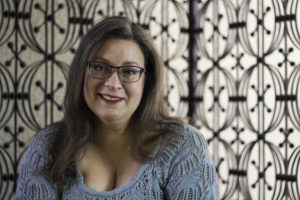
By Elizabeth Donald

This month was a milestone for me, as my long-running short-story anthology finally went out of print after 15 years and I sold my last copy at a book signing in Memphis.

Setting Suns wasn’t my first book, but it was the first to appear in paperback. Way back in the dawn of the ebook era, my first novel Nocturnal Urges came out from Ellora’s Cave Publishing, but they only published in ebook (two years before there was even such a thing as a Kindle!). If the ebook did well, they released it in paperback later.

Nocturnal Urges came out and it sold well, won awards and the publisher demanded a sequel despite all the people insisting, “I’ll wait until the real book comes out.” I kept yelling, “It IS a real book! Ebooks are real books!” Now people look at my paperbacks and say, “I’ll get the ebook,” and I want to yell, “Where were you in 2005??”

I was working on that sequel when Frank Fradella, founder of New Babel Books, came to me with the idea of putting my short stories into a collection. I’d published a handful of short stories in horror and science fiction magazines that had a disturbing habit of going out of business right after they published me. I was the Typhoid Mary of the small press in the early 2000s. Frank suggested collecting those stories and writing another half-dozen or so just for the collection, and thus Setting Suns was born.

It wasn’t my first book. But it was the first time I opened a box of books and saw my name on the cover. Ask any writer about that moment, and see the look in their eyes when they remember.
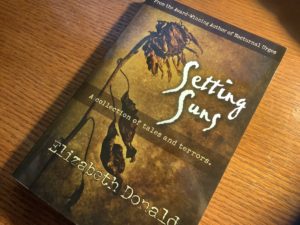
Setting Suns has been in print for 15 years, give or take, and that’s one hell of a good run for a small press collection. It won the Darrell Award for best short story for “Wonderland,” a weird little Frankenstein riff told entirely in emails and online chats that gave Frank apoplexy in layout, and contains two of my most popular short stories: “Sisyphus,” a tragedy exploring toxic grief and lost love; and “Jesus Loves Me,” known as the Evil Teddy Bear story.

The Evil Teddy Bear still exists, here in my office. And there were T-shirts.

But there are other stories that didn’t get as much attention. There’s “Prisoner’s Dilemma,” a literal funhouse horror piece that looks at the different kinds of love a person can have for the people in her life, plus crazy man with gun.

There’s “Silent,” which was one of my very first short stories to be published for money, that smacks of a haunted house as told by The Twilight Zone. There’s “Deep Breathing,” a future-world submarine scarefest involving a monster several readers have referred to as “Cthulu-esque” which was funny because I’d never read Lovecraft at that point.

There’s “Memory Lane,” another escapee from Twilight Zone about a husband’s desperate search to find his missing wife, and the dark secrets that come to light. That one began as my first attempt at a short-film screenplay, rewritten as a short story for Setting Suns.

There’s “Gauntlet,” an action-flick of a science fiction story set in my Sanctuary universe that only reaaaaally dedicated readers know about, since it’s had a couple of stories published but the novels remain in the trunk until I get them to not suck. Three of the Setting Suns stories are set in Sanctuary, but “Gauntlet” is my favorite.

There are even two stories that would qualify as “literary” with no SFFH elements whatsoever, though entering an MFA program and exploring literary fiction was the absolute last thought on my mind in the waning years of my twenties.

After 15 years, Setting Suns was still the “entry drug” for Elizabeth Donald fiction. Long-time readers sometimes tell me it’s their favorite of my titles (which is a little humbling since I’ve published maybe fourteen books and novellas since then, give or take a few).

I’m gonna miss the old girl.

I want to thank Shane Moore, current publisher of New Babel Books, for working with me to put Setting Suns out of print with grace.

I also want to thank Frank Fradella, who is no longer with New Babel Books, for his contributions to making Setting Suns what it was. The book was Frank’s idea, and his editing, layout and design coupled with the cover art from Darren Holmes made a wonderful book that I was proud to call my first.

Thanks also go to Jason R. Tippitt, who co-authored one of the stories with me (“I Live With It Every Day”) and served as sounding board and inspiration through much of the book’s development. I very rarely work in partnerships – I don’t play well with others – and it is a testament to Jason’s patience and skill that our story turned out well. The book was dedicated to Jason, who is a fine writer and I hope you’ll hear more from him in times to come.

It’s been a terrific run for my first “real” book, at least as far as I’m concerned. I hope you enjoyed the ride.

Elizabeth Donald is a dark fiction writer fond of things that go chomp in the night. She is a three-time winner of the Darrell Award for speculative fiction and finalist for the Prism and Imadjinn awards, author of the Blackfire urban fantasy series and Nocturne vampire mystery series, as well as other novels, novellas and stories in the horror, science fiction and fantasy genres. More recently, she was awarded the Mimi Zanger Literary Award for fiction. She is the founder of the Literary Underworld small-press cooperative; an award-winning journalist and essayist with more than twenty years in journalism; a nature and art photographer; freelance editor and writing coach. She is currently completing two masters degrees at Southern Illinois University Edwardsville and teaches newswriting and English composition at the university. She serves as president of the St. Louis Society of Professional Journalists and Eville Writers, vice president of Phi Kappa Phi and Sigma Tau Delta at the university, and is a member of the national SPJ Ethics Commission, AEJMC, Editorial Freelancers Association and many other organizations for which she volunteers. She lives with her family in a haunted house in Edwardsville, Illinois. In her spare time, she has no spare time. 

www.elizabethdonald.com

www.donaldmedia.com

elizabethdonaldphotography.com

Writing isn’t Exactly a Healthy Profession

By Nicole Lanahan

It’s no secret that a writer’s job requires a lot of sitting—there are days when the only time I get out of my chair is to get a refill of coffee. And let me tell you, that much butt-in-seat action may be good for your writing output, but it’s not good for your butt—or in my case, my cholesterol. I had my annual bloodwork done at the beginning of the year, and the results were not great.

I’m getting older. It happens to the best of us. And my body can’t rebound from writing like it could when I was in my 20s. Let’s face it, most writers have day jobs and families. How are we supposed to go to the gym and cook healthy meals when we’re trying to meet deadlines?

The pandemic has been hard on all of us. If you were like me, most of your dinner came from a bag. The result was exactly what you’d think it would be. I was tired all the time, my complexion was a mess, and my cholesterol was through the roof. After a pretty serious conversation with my doctor, I promised to make some changes. I’ve started walking daily at the park and started making healthy eating choices. So this year I vowed to make a change and I’m happy to say I’m down nearly twenty pounds since January, I have more energy, my skin has cleared up, and my cholesterol levels are down enough that I no longer need medication.

Mornings have always been especially hard for me to make good diet choices. Either I want something sugary (I’m talking to you, Starbucks Frappuccino), or I skip breakfast all together. Now that I’ve discovered a healthy, delicious replacement for my usual sugar-filled coffee, I don’t suffer from the afternoon sugar crash. This means I’m in a much better position to write in the afternoons when I get off of work instead of succumbing to the dreaded sugar crash.

I’d love to hear from you. Do you have any secrets for staying healthy while writing?

Niki Alba’s Morning Coffee Protein Shake

1. 1 C. Ice (there’s 2 in the picture because I made a double batch)
2. 1/2 scoop of protein powder. All I had on had on hand was cookies and cream, but chocolate powder or my favorite salted caramel would make this killer
3. 1/2 frozen banana. Learn from my mistake. Peel this bad boy before you freeze it.
4. 1/2 C. Unsweetened almond milk
5. 1/2 C. Coffee (again, there’s more in my pic because I made a double batch.)
5. Optional 1 stevia packet

Throw all ingredients in blender, blend, and enjoy your only 150 calorie coffee protein goodness!

——

At seventeen, Nicole Lanahan found herself homeless with only a beat-up Volkswagen Jetta and a bag of Goodwill clothing to her name. The only things that got her through the nights she spent parked in truck stops and cornfields were the stacks of books she checked out from the library along with her trusty flashlight. Because of the reprieve these books gave her from her troubles, she vowed to become a writer so she could provide the same escape to readers who needed a break the reality of their own lives. She has written as both Nicole Lanahan and Cole Gibsen. 


Love story or romance?

And why, if you choose to ignore the difference, you should invest in fireproof underpants.

By Sela Carsen


Wuthering Heights is not a Romance. Literary theory may classify it as a romance, but that is not the same thing as Romance.

See the difference there?

That capital R indicates genre Romance, as opposed to the entire movement of literature that gets categorized as romance (did you know that Robert Burns’ poem about lice in a pretty girl’s hair is “romantic” because it’s about nature?), or millennia’s worth of love stories that fall under the same label, though the vast majority of them end miserably.

But here we are in the 21st century, and people still can’t quite wrap their head around the difference between the variations. I mean, it’s clear enough if you send your spouse to the grocery store to get “cheese,” then grind your teeth if they come back with cheddar instead of cotija, because those are clearly different things… that both use the same word.

For today’s exercise, let’s discard the stories that get labeled “romance” simply because they were written in the “romantic” era of the late 18th and early 19th centuries in Europe. According to Wikipedia, “Romanticism was characterized by its emphasis on emotion and individualism as well as glorification of all the past and nature….”

Nothing in that statement specifies tales about relationships, so let’s stick with stories that focus on romantic love.

Part of the trouble we have with defining our terms comes from the archetypical “romantic hero” who became popular during this era. Whether the stories involved a romantic relationship or not, they centered around certain types of characters. Either the brooding, solitary hero who rejects love because he’s somehow unworthy, or his counterpart, the waif-like, long-suffering heroine whose life is dictated by the harshness of her rational, patriarchal family. Because extreme emotion was the hallmark of the movement, those archetypes have stuck with the label of “romantic,” which isn’t necessarily a match for writing a Romance.

Capital-R Romance, however, is a very specific genre of literature that doesn’t concern itself with glorification of all the past and nature. Instead, it has two main focuses: the “Rules of Romance,” if you will.

A Central Love Story: The main plot centers around individuals falling in love and struggling to make the relationship work. A writer can include as many subplots as he/she wants as long as the love story is the main focus of the novel.

An Emotionally Satisfying and Optimistic Ending: In a romance, the lovers who risk and struggle for each other and their relationship are rewarded with emotional justice and unconditional love. (Romance Writers of America)

Nothing there about staring across the windswept moors or digging up your dead lover’s grave to beg her to haunt you so you can make everyone in a ten-mile radius miserable for the rest of your life. (I’m lookin’ at you, Heathcliff!)

There’s also nothing there about having one half of the relationship die tragically of cancer or in a car wreck or in childbirth or anything else. *coughNicholasSparkscough* No one cheats, no one gets bored, no one leaves.

And before you snort disdainfully and go, “That’s not realistic,” I ask you if zombies are realistic. Or demons that bubble up from cracks in the earth. Or whether you’ve ever actually encountered a hard-smoking, hard-drinking, hard-boiled detective who referred to women’s legs as “gams” in real life.

It’s. Fiction. People.

Love stories often get the first part right, the main focus on the relationship, but then take a left turn before getting to the part about the optimistic, satisfying ending with the lovers together. You can write a beautiful story where the relationship doesn’t work out, but the main character moves on happily. But if the lovers aren’t together happily, then it’s a love story, not a Romance.

Two people.* Together. Happy Ending. That’s a Romance.

Capital R Romance is about making readers end a book with a smile and a happy sigh, rather than a bewildered, horrified, and tear-drenched, “WTF did I just read?!? What is wrong with these people?!? Did no one learn anything?!?!?”

Whether it’s filled with sexy bits or not (my best-sellers have zero touchy-time on the page), whether it’s set in ancient Rome or in a galaxy far, far away, or in some fictional midwestern small farming town, whether it has vampires or werebears, or billionaires who are suddenly single fathers and down-on-their-luck waitresses/nannies, all Romances follow the above two rules.

Want to write a gorgeous novel that focuses on two people in a zombie apocalypse finding each other and struggling to make their relationship work… then one of them dies (like, all the way dies, doesn’t come back to life with a craving for human flesh), leaving the other a lone, tragic figure?

That’s awesome! Do it! But it’s not a Romance. It’s a love story.

Want to write a beautiful novel that focuses on two teens, but the boy is a zombie who eats the brains (and memories) of his girlfriend’s dead ex-boyfriend, and even though he stays a zombie, he sort of gets much better, and even though her zombie-hunting dad wants to kill him, the boy and girl overcome their human/zombie differences and stay together?

Don’t write that. Someone already did, it’s called Warm Bodies by Isaac Marion, and it’s freaking adorable.

But you could write your own zombie Romance as long as it ends with the two happily getting together and staying together!

Now let’s put on our author hats. The business hat, not the creative one.

Romance is a marketing term. It’s designed to let readers know what they’re picking up in much the same way that the terms mystery and thriller signal certain expectations to readers.

Romance readers are a savvy bunch of (mostly) women who drop billions of dollars a year on those Happy Ever Afters. They’re socially connected, they belong to vast communities of other readers, and they do not like getting tricked because you think you’re going to “turn romance on its head,” or you don’t like genre limitations, like that daft rule about how you always have to reveal whodunnit at the end of a mystery novel.

You’re an artiste! No one can tell you what to do! And those silly Romance-reading women with all that disposable income should appreciate your avant-garde approach to educating them and teaching them to read “better books.”

*snort*

Try it. I’ve got a bag of marshmallows to roast on the bonfire they’ll light around your flaming literary oeuvre and the ashes of your career. Or, as they call it in the Romancelandia territory of Twitter, “every other Tuesday.”

That attitude is not special, or unique, or clever. It IS however, probably some combination of pretentious, ignorant, and/or misogynistic.

Labeling a book as a Romance has meaning, and mislabeling shows that the author either doesn’t know what they’ve written, or they’re deliberately trying to mislead potential readers. Because I can absolutely guarantee that Romance readers understand their genre, and they read it specifically for that Happy Ever After satisfaction. They can get misery anywhere, but they pick up a Romance to get that happy sigh at the end. If the author doesn’t deliver, they have wildly misjudged their readership.

Note: Romance isn’t limited to just two people. There are entire niches filled with polyamorous but committed groupings. Romance has also become very open to non-het, non-cis, non-binary characters and relationships. Love is love.

Writing a Romance and labeling it correctly not only ensures that you’re going to hit your target market correctly, thereby putting you in a position to sell well, but it also indicates a basic level of respect for the readers.

So if you choose to write a relationship-based story, know that the conclusion dictates the marketing, and it’s up to you to understand the differences in how they’ll hit the readership.


Sela Carsen is an award-winning author of paranormal and sci-fi romance — with or without sex and dead bodies. Your pick. She also writes steamy contemporary romance as Silke Campion. Check out many of her titles on The Literary Underworld.