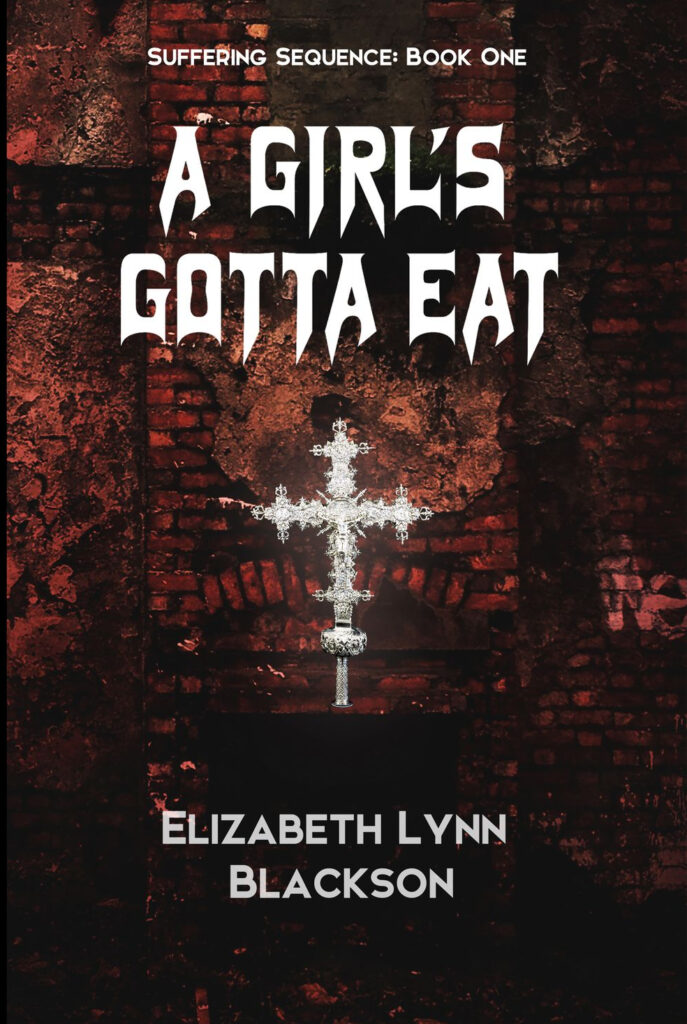
By Elizabeth Lynn Blackson
I need to tell you a secret: I am a fraud. I’m a complete fake. I don’t have a degree in English. I have no piece of paper declaring myself competent. Nothing.
I’m no author.
That’s the voice of my harshest critic: me.
Stephen King has been quoted as saying “If you wrote something for which someone sent you a check, if you cashed the check and it didn’t bounce, and if you then paid the light bill with the money, I consider you talented.”
Damn. That quote is a powerful tool against my raging Imposter Syndrome, and frankly, it’s something I occasionally dearly need to hear.
There is this long, terrifying space in the process of writing. Not the slap-dash first draft. Not the hours of honing, or reading and rereading, looking to spackle plot holes closed. Not going through dialogue, looking for opportunities to strengthen character through their voice. Not researching absurd facts, like whether a Glock 17 has a last-round hold-open on the slide.
When you buff and polish, and format and publish and then…
Then you wait. And you hope for positive feedback. And you get… not much. Sometimes none. If you’re lucky enough to have a few reliable beta readers, whatever momentum you got from their enthusiastic cheering fades, and you wait.
I finished an entire trilogy of urban fantasy/horror novels collectively known as “The Suffering Sequence.” And then…
Nothing.
I don’t know how to market. Maybe worse, I do not wish to learn. I HATE the face-forward portion of this process. If I felt fake calling myself an author, I feel doubly so trying to be my own hype-woman. “Read my stuff. I’m amazing.”
I hate the ‘elevator pitch’ and the ‘back cover blurb.’ I hate selling myself as an author, but unless I plan to magically find funds to hire someone else to do it, I’m… stuck.
I’ve written over a million words of fiction: seven entire novels, co-authored two other novels, only four of which ever saw the light of day. I’ve DNFed several more novels around the halfway mark. I have written three other novellas, which are frankly fan-fic, but (I feel) important building blocks to longer works. I have also written a fair bit of short fiction, enough at least for several collections.
Minus one novel written with Scrivener, all of them have been created in simple word processing programs. I’m writing this using Google Docs, which is what I used to write the entire “Suffering Sequence” trilogy.
I have had issues with finding cover artists, editors, publishers, and at every turn it’s felt like the world conspired against me to place barriers to completion. Add frustration, impatience, and lack of funds to the Imposter Syndrome.
In the early 90’s, I was working with a friend on small press comics. While sitting at a booth, selling our wares, there was another artist next to us, and we struck up a conversation. The topic wandered to the parts of the process that are in our control, and the difficulty of the whole process. He said, paraphrased, that it was a lot of effort even to make garbage. That notion has stuck with me. Even in the age of print on demand, creating a finished book is a lot of work.
After having a cover artist’s delay in getting his assignment completed, I became gun-shy of farming out ANY part of the process.
That’s when I remembered something that I frequently shove aside in the mad dash toward monetization of any skill: I make art. I write. I create fonts. I draw and I paint.
I remembered that even if I was reduced to a physical spiral-bound notepad and Bic pen, I would still write and draw.
I painted the cover image of my latest collection with poster paint from Dollar General. I might complain mightily, but I still create. It seems to be an innate part of me, and budget constraints are only limiter as to what tools I use.
When I pulled my head out of the mire of depression, I remembered I was an artist.
ELIZABETH LYNN BLACKSON grew up in a small town in Eastern Ohio, living on a steady diet of comic books, horror movies, and Stephen King novels, while playing D&D and listening to heavy metal. It twisted her into the maniacal creature you now see before you. While certain she was going to be a comic artist, life pulled her in a different direction, and she ended up in the St. Louis metro area, where she lives with her hubby and two cats. Check out her work on the Literary Underworld!