By Alexander S. Brown
I would like to start this by giving thanks to the Literary Underworld for granting me the opportunity to elaborate on my collection, 13 Octobers. Since this will primarily focus on why I chose to release this collection as an author’s preferred edition, I will spare the reader of what inspired this work in the first place. If you’re interested in those details, just visit my YouTube page Bookworm of the Damned and watch my video entry titled “Great News.”
Originally 13 Octobers was released in 2016. Back then, it was called The Night the Jack-o’-Lantern Went Out. Which despite how cool of a title that was, I couldn’t take credit for its name, as that was suggested by my publisher. And for this reason, when I decided to make this collection available to the public once again, I changed the name simply because it felt right.
Primarily, there were quite a few reasons why I decided to pull my work and regain my rights. But instead of listing everything that went wrong, or what I considered to be a red flag, I’ll stick to the main factors that played into 13 Octobers becoming my preferred edition over the original text.
The main problem I had with The Night the Jack-o’- Lantern Went Out was because it had been published with a plethora of errors. And when I brought this to the publisher’s attention, I was told it wasn’t a big deal. It may not have been a big deal to him, but it was to me. After I requested a revision multiple times, and nothing was done, I came to the realization that no changes would be made. Imagine the frustration there.
As other issues began to mount, the weekend that made me decide to yank all of my work took place at a horror convention where I had been invited as a guest. At this convention, my publisher and I sat on a panel together to speak about the horror fandom. Shortly after we introduced ourselves to the audience, he said, “Horror is a dead genre.” Then he proceeded to explain how horror doesn’t sell.
All I could do was sit there and think, well, you just shot yourself in the foot. Then I asked myself, if the genre is so dead, why are you representing me? Since I wasn’t in the mood to argue, I expressed how I saw the genre reinventing itself. Once the weekend concluded, I mulled over a gameplan to regain my rights, which resulted in me sending an email that expressed it was time to part ways. Of course, I was met with resistance, but I eventually got what I wanted.
From there, my work went out of print, but I knew I needed a creative outlet. For that reason, I began the YouTube channel Bookworm of the Damned. This came about mostly because I wanted to document what I read and connect with other readers. Since I had spent nearly the last decade doing conventions and speaking on panels, I had a good idea of how I wanted to present myself.
But while my main focus became directed at this channel, I couldn’t just throw away my books altogether. Because of that, I decided I would to return to the author life when it was right for me. Nonetheless, I continued to write new stories, until I felt it was time to return my attention to my previous published works.
Among my out-of-print collections and novel that I had released over the years, I decided to tackle The Night the Jack-o’-Lantern Went Out first. In 13 Octobers, I give a deeper meaning why I chose this collection first. But for here, I will simply say the subject matter was symbolic and comforting, as many of its characters reminded me of my family.
When time would allow, I tried to eliminate plot holes, gain historic accuracy, and fix grammatical and spelling errors that had gone untouched with its first printing. Then I handed my book over to friends and family, who I trusted could give me constructive criticism, which they did. Over the better part of two years, we corresponded frequently about what needed to be revised, and had it not been for their help, I doubt I would be writing these words now. Also, since the original cover art for The Night the Jack-o’-Lantern Went Out was provided by the publisher, I knew I wanted a new cover. I reached out to local artist Chuck Jett to create the current image.
Being DIY with this book was a great learning experience, especially when it came down to formatting the ebook and paperback. But to prevent future struggle, I made notes from beginning to end of the steps I took for 13 Octobers to exist. While going through all of these steps did prove to be a headache, the fact that I now have complete control over my work, and I can make changes whenever I like, I can sleep better at night.
Before I close out, I would like to advise that not all publishers are like the one I described. Please don’t think I’m bashing all publishers. Nonetheless, if you are interested in a publisher, no matter what size house they are, purchase a few of their books and read them. When finished, ask yourself if the book was good quality. Then go online and research the publisher. Not only will a quick search help you determine how established their house is, but it will also allow you to see if the publisher has been in hot water. Furthermore, if you’re able, reach out to authors of that house, inquire about their publishing experience, as well as how loyal that publisher has been with sharing royalty statements.
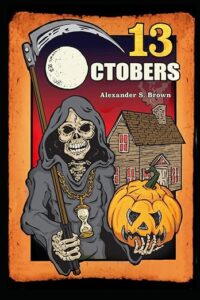 In this mixed bag of treats … and tricks, readers will return toI/ older times. Back when oral tradition warned of grisly things that lurked about on autumn nights. A bygone era when people heeded superstitions and lore, and few dared to brave the forbidden.
Readers will encounter thirteen chilling stories presented in four decades of vintage life. These horrors include: ghosts, unlucky animals, murderers, creatures, and the devil himself.
ALEXANDER S. BROWN is a Mississippi author whose first book, Traumatized, was published in 2008, later re-relased by Pro Se Publications. Brown is currently co-editors/coordinator with the Southern Haunts anthology series published by Seventh Star Press. His horror novel Syrenthia Falls was published by Dark Oak Press. His short story collection The Night the Jack O’ Lantern Went Out reached bestseller status in three literary categories on Amazon.com upon release. Brown is the author of multiple young-adult steampunk stories found in the Dreams of Steam anthologies, Capes and Clockwork anthologies, and Clockwork Spells and Magical Bells. His more extreme works can be found in the anthology Luna’s Children published by Dark Oak Press, Reel Dark published by Seventh Star Press and State of Horror: Louisiana Vol. 1 published by Charon Coin Press. Brown is also an actor and producer in the short film The Acquired Taste inspired by a story in Traumatized and directed by Chuck Jett.
 writing books, she’s a librarian at a local library, which is kind of a superhero. Her superpowers include always knowing what kids like to read, being able to read more than 10 books at one time, and the ability to eat more pizza than anyone.
 continues with the recent Mother of Centuries. His work has appeared in The Twilight Zone Magazine, Eldritch Tales, National Lampoon, River Styx, Tornado Alley and the anthology A Treasury of American Horror Stories, which also included stories by Stephen King, Richard Matheson and H.P. Lovecraft. He has written extensively on historical and arts-related subjects and has been a guest lecturer in fiction at Washington University in St. Louis. He is a lifelong Bigfoot enthusiast, and Annette: A Big Hairy Mom is his first novel for young readers.
 STEVEN L. SHREWSBURY lives, works, and writes in rural Illinois. More than 360 of his short stories have appeared in print or electronic media, along with more than 100 poems. Nine of his novels have been released, with more on the way. His books run from sword & sorcery (Overkill, Thrall, Bedlam Unleashed) to historical fantasy (Godforsaken) extreme horror (Hawg, Tormentor, Stronger Than Death) to horror-westerns (Hell Billy, Bad Magick, and the forthcoming Last Man Screaming). He loves books, British TV, guns, movies, politics, sports and hanging out with his sons. He’s frequently outdoors, looking for brightness wherever it may hide.


 Rachel A. Brune graduated from the NYU Tisch School of the Arts in May 2000, and was immediately plunged into the low-stakes world of entry-level executive assistantship. Her unexpected journey out of that world and into the military is chronicled in her self-published book Echoes and Premonitions. Rachel served five years as a combat journalist, including two tours in Iraq, and a brief stint as a columnist for her hometown newspaper. After her second tour, she attended graduate school at the University at Albany in NY, where she earned her M.A. in political communication, and her commission as a second lieutenant in the military police corps.

 A Girl’s Gotta Eat
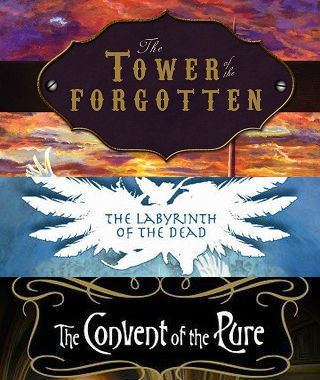 wrapped in dark magic and scented with blood. Portia came to the convent with the ghost of Imogen, the lover she failed to protect in life. Now, the spell casting caste wants to make sure that neither she nor her spirit ever leave. Portia’s ignorance of her own power may be even more deadly than those who conspire against her as she fights to fulfill her sworn duty to protect humankind in a battle against dark illusions and painful realities.